

















VijAI Enquire Now
VB Rakshak, the VB Group safety character, in an orange suit and blue cape with a white VB hard hat

VijAI · AI vigilance on the CCTV your plant already has

You cannot be present in all three shifts. Nobody can.

LiveShift C · 22:00 to 06:00Detection by default

Live floor Cleared, keeps walking Stopped, turns back Vehicle movement

What VijAI is

VijAI is an industrial AI vigilance platform that runs on a plant's existing CCTV. Nine modules watch for PPE gaps, unsafe acts, fire and smoke, restricted zone entry, vehicle movement, machine guarding, intrusion and evacuation headcount, then alert the responsible person in real time. Built in India, from VB Group, since 2014.

Surveyed, installed and commissioned by our own engineers. Three deployment models, and nobody is subcontracted.

They trust VB

Client logo Client logo Client logo Client logo Client logo Client logo Client logo Client logo Client logo Client logo Client logo Client logo Client logo Client logo Client logo Client logo Client logo Client logo

01 The floor, not the policy

Nine moments, and the module that answers each one.

So the helmet goes on at the gate and comes off two hundred metres in, the guard goes back on when somebody remembers, and the tape that came down for the shutdown is still down three weeks later.

01 / 09

PPEAI

CAM 01 · illustrative

01 PPEAI

The gate

He put the helmet on at the gate. Two hundred metres in, it is in his hand.

It is 44 degrees and the helmet is hot, and the gate is where the checking happens.

PPEAI checks at the work face, not at the gate.
GESTEAI

CAM 02 · illustrative

02 GESTEAI

The jam

He reached in to clear the jam, because switching off means finding the electrician and losing forty minutes.

The isolation procedure is slower than the fault.

GESTEAI sees the reach-in while the machine is still running.

GUARDAI

CAM 03 · illustrative

03 GUARDAI

The press

The guard came off to clear the jam. It went back on when somebody remembered.

Production had to run, and nowhere in the system is there a place to record it.

GUARDAI watches whether the guard was in place, cycle by cycle.

ZONEAI

CAM 04 · illustrative

04 ZONEAI

The shutdown area

The barricade tape came down for the shutdown. Three weeks later it is still down.

Tape is temporary, shutdowns are not, and putting it back is nobody's named job.

ZONEAI keeps the boundary in software. It cannot fall down.

DRIVEAI

CAM 05 · illustrative

05 DRIVEAI

The aisle

The walkway has pallets on it, so people walk in the forklift aisle.

Storage is full and the walkway is the only clear floor left.

DRIVEAI counts every time a person and a vehicle share an aisle.

SAFEAI

CAM 06 · illustrative

06 SAFEAI

The stairs

Nobody holds the handrail on those stairs. You have raised it in three toolbox talks.

The stairs are quick, the rail is greasy, and nothing has ever happened.

SAFEAI counts it every time, so month end brings a number instead of a complaint.

FIREAI

CAM 07 · illustrative

07 FIREAI

The cable trench

A cable trench smoulders for twenty minutes before anybody smells it.

A ceiling detector in a twelve metre shed waits for the plume to climb.

FIREAI sees smoke where it starts rather than where it arrives.

PULSEAI

CAM 08 · illustrative

08 PULSEAI

The mock drill

Forty minutes to be certain of the headcount, and the drill was the easy version.

Contract labour changes daily, so the gate register and the muster list never match.

PULSEAI counts who reached the muster point while the drill is still running.

SECUREAI

CAM 09 · illustrative

09 SECUREAI

The boundary wall

One guard, and one and a half kilometres of boundary wall.

Arithmetic, the same arithmetic as the three shifts.

SECUREAI watches the whole perimeter at once.

02 Running today

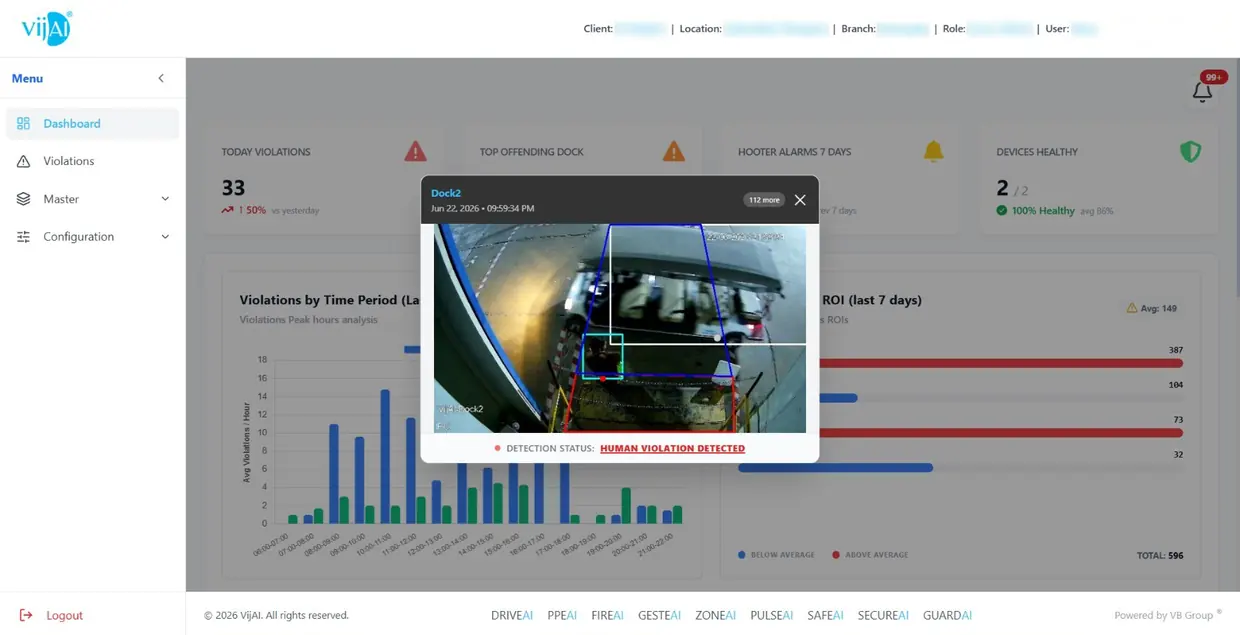
This is the screen, and this is what it saw.

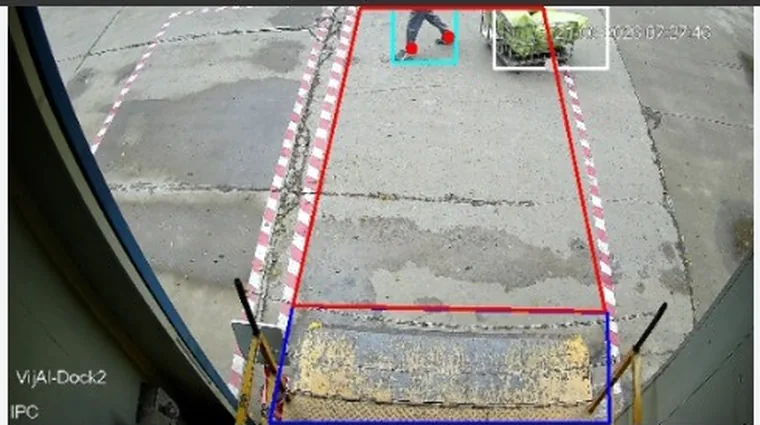
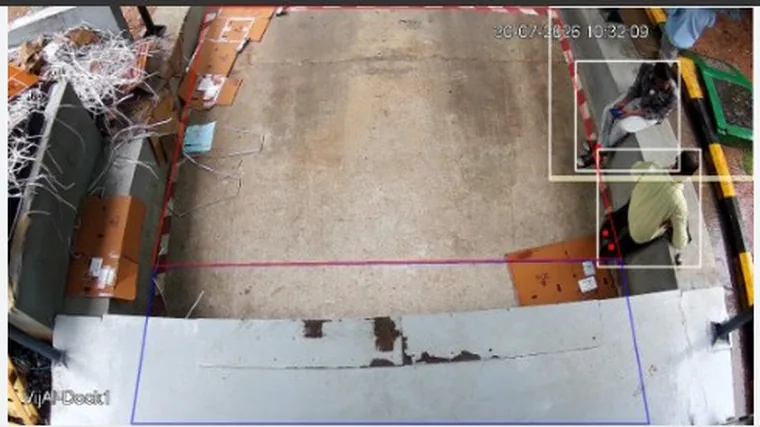
Not a concept render. The dashboard below is the live VijAI console, and the two frames beside it are real detections from a working dock. Client identity is masked in both.

VijAI console · violations, docks, device health
VijAI console showing today's violation count, violations by time period, top offending dock and device health, with an open detection frame
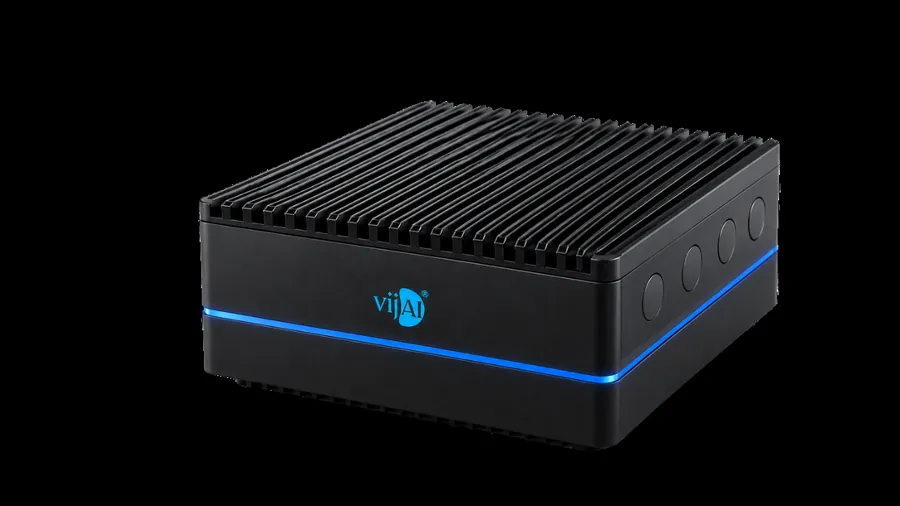
VijAI edge compute device, a finned black unit with a blue light bar and the VijAI wordmark

One box behind the cameras

The edge unit sits in the panel next to your existing recorder. Nothing goes on the walls, nothing is re-cabled, and no camera is replaced.

Detection frame from a loading dock, with a person bounded in cyan, a vehicle bounded in white and the marked dock zone outlined in red and blue

Dock 2 · human violation detectedPerson inside the marked vehicle zone while the dock is live

Overhead detection frame from a second dock showing two people bounded inside the restricted loading area

Dock 1 · human violation detectedTwo people inside the loading envelope during a movement

03 Installed and running

Since 2014. Not a pilot.

VijAI runs on the cameras a plant already owns. No new hardware, no rip and replace, no second network to maintain.

100+

Plants and sites where VijAI modules are running

18,200+

Unsafe acts recorded, timestamped and located

95.8%

Prediction accuracy across the deployed estate

0

New cameras required to start

Source · VijAI deployment register, VB Group, September 2026.
Site definition and observation period are stated in full in the statistics register.

04 In their words

Four things an EHS head says to another EHS head.

Nobody types these into a search box. They are what the job actually sounds like, and none of them is a failure of a person.

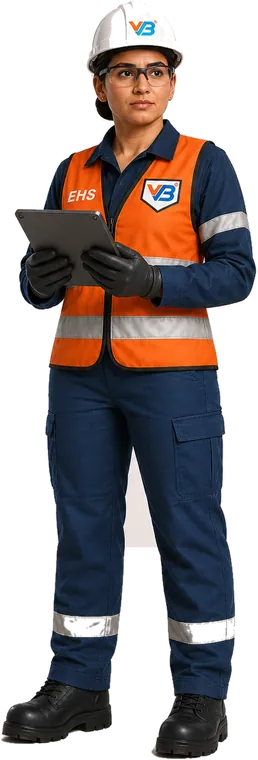
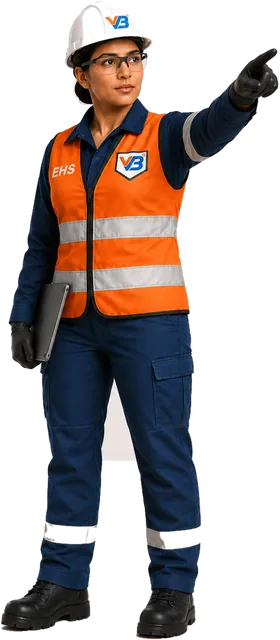
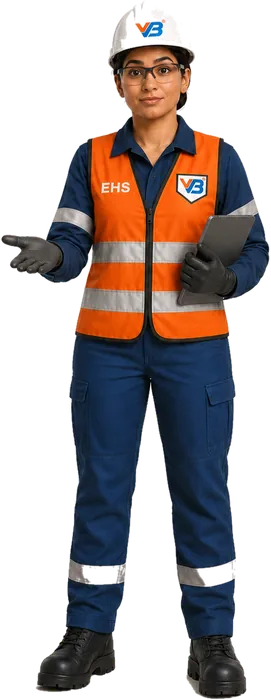
Chetna, the VB EHS engineer character, in an orange hi-vis vest and white VB hard hat holding a tablet

The drill went fine. I still cannot tell you if everyone was out.

Contract labour changes daily, so the gate register and the muster list were never the same document. Counting people who are moving, in the dark, under time pressure, is not a discipline problem.

PULSEAI counts who reached the muster point while the drill is still running.

Nobody challenges a senior man in a hurry.

Challenge depends on rank, and rank does not change because a rule exists. Your team can be excellent and still not be the person who stops him.

The observation is made by the camera, so nobody has to make it in person.

The guard came off at 2am. Nobody put it back.

Production had to run and there was nowhere in the system to write it down. Not for want of effort. For want of an engineered control to write instead.

GUARDAI records whether the guard was in place, cycle by cycle.

The tape came down for the shutdown. Three weeks on, it is still down.

Tape is temporary and shutdowns are not, and putting it back is nobody's named job. Concurrency is geometry, not effort.

ZONEAI keeps the boundary in software, where it cannot fall down.

None of the four is searchable, which is why this band exists. The pages that rank are further down. Lines shown are the approved voice examples from the VijAI Rule Book, held in place until the harvested lines are signed off.

VB Rakshak holding a tablet, representing the engineered control that answers the moment

05 The argument your plant head will accept

Work does not stop for safety. Work stops for accidents.

Nothing stops while the PPE is on. VijAI raises an observation, names the area and the time, and lets the shift decide. The line keeps running. What changes is that the thing was seen at all.

1 hour

A stoppage, cleared and back on the plan by the end of the shift.

3 days

An incident. The line, the enquiry, the corrective action, the restart.

1 audit

A customer audit nobody planned for, on a date nobody chose.

1 month

Somebody senior writing a report instead of running the plant.

Every one of those four costs more than the alert that would have arrived first. The cheapest hour in a plant is the one where somebody was told early.

06 The record

After an incident, the question is never whether a rule existed.

It is whether anybody saw it coming, and whether that is written down from before. A plant that can answer the second question is in a different conversation from one that cannot.

Before

The pattern is already counted

Every observation carries an area, a camera, a date and a time. Nobody has to remember to write it down, because writing it down is the system.

The day

The file exists in advance

The history of that area is retrieval, not reconstruction. It was recorded while the plant was running normally, which is what makes it worth reading.

After

The corrective action has a baseline

The same count continues after the change, on the same cameras and the same rule, so improvement is measured rather than asserted.

The Factories Act, 1948 was repealed in November 2025. The instrument in force is the Occupational Safety, Health and Working Conditions Code, 2020, published at India Code. National factory and inspectorate statistics are published by DGFASLI.

07 Where it runs

The same nine modules, set up for your floor.

The moments are the same everywhere. What changes is which of them matters most, and that is decided in the survey rather than in the brochure.

08 The buying committee

Three people have to sign. Only one of them works on safety.

Your champion is the EHS Head. The two people who can stop this have never met the product and will each ask one question. Both answers are on this site, written so they can be forwarded without a covering note.

Chetna, the VB EHS engineer character, pointing towards the buying committee questions

EHS Head · the champion

Will this hold up in front of an inspector?

Every observation carries an area, a camera, a date and a time, and the same rule runs on every shift. The record is built while the plant is normal, not after something happens.

IT and Legal · the blocker

Where does the video go, and is this lawful?

Detection by default, identification optional. The plant decides notice, purpose and retention. Enquiry data is held in India.

Finance · the gate

What does this cost per camera?

It runs on cameras already installed, so the first number is software and commissioning, not capital. A pilot is priced as one plant, one module, thirty days.

09 From the ground

Three frames still to be shot.

The console and the detection frames above are real. These three slots are the site photography that does not exist yet, and they stay marked until one day at one consenting plant.

Slot 01 · establishing frameWide shot of the shop floor with the camera positions visible

Slot 02 · commissioningEngineer setting a zone on site

Slot 03 · the muster pointPeople gathering during a drill

10 How it runs

Three ways to deploy it. Your network decides which.

The first question IT asks is where the video goes. All three answers are here, and detection by default with identification optional applies to every one of them.

ModelWhere the video is processedWhere it fits
On-premise edgeEntirely inside the plant. Nothing leaves your network.Licensed areas, sites with a data-residency rule, and plants with no dependable outbound link.
HybridRecommendedDetection at the edge, dashboards and reporting hosted. Footage stays on site. Only events leave.Most plants. Video stays inside the boundary and head office still gets one view across every site.
CloudProcessing and storage hosted.Single sites, short pilots, and estates already running their VMS this way.

The model is chosen in the survey, against your network and your data rules. It is not a price tier.

11 Who installs it

Nobody is subcontracted.

Survey, engineering, installation, commissioning, calibration, training and support are all done by VB people. When a camera angle is wrong on a Sunday night, the person who fixes it is the person who chose it.

  1. Site surveyEvery camera checked for angle, light and coverage against the rules you actually need.
  2. EngineeringRule sets configured area by area, not one setting for the whole plant.
  3. InstallationBy VB engineers, working to your permit system.
  4. CommissioningCalibrated against your own footage until the counts hold.
  5. TrainingFor the EHS team and for the operators who will see the alerts.
  6. SupportFrom the same engineers. Not a ticket queue.

12 Before a pilot

The five questions we are asked first.

What is VijAI?

An AI vigilance layer for industrial plants. It reads the feed from cameras already installed, applies nine detection modules, and raises an observation with the area, the camera, the date and the time attached. From VB Group, running at Indian sites since 2014.

Do we need new cameras?

No. VijAI works on the existing CCTV in most plants, including mixed-vendor fleets. A survey checks angle, coverage and light on each camera and says which of the nine modules that camera can support. Where a view is genuinely blocked, we say so.

Is monitoring workers with AI lawful in India?

VijAI runs by default in detection mode, which does not identify individuals. Identification is a setting a plant enables deliberately. Notice to workers, purpose limitation and retention are set by the plant. Enquiry data is held in India. The legality briefing is written for HR and legal.

Which modules suit my industry?

That is decided in the survey, not in advance. Warehousing usually starts with vehicles and aisles, pharma with gowning, chemical with restricted zones, mining with vehicle movement. Most plants start with one module and add the second after the first month of numbers.

How does a pilot start?

One plant, two cameras, one module, thirty days. We agree the pass criterion in writing before it starts, so the result is a decision and not a discussion. If the alerts turn out to be noise, you have lost a month and nothing else.

13 How VijAI helps

You stop arguing from judgement and start arguing from a count.

VijAI is a vigilance layer on the CCTV your plant already runs. It covers the hours you cannot, counts what is actually happening on the floor, and tells someone while there is still time to act. Four things change, in the order you will notice them.

Today

Shift C runs from 22:00 to 06:00 and there is nobody standing on the floor to see it.

With VijAI

The same rule runs at 3am as at 3pm, and it writes the same record either way.

Today

An observation exists only if somebody stops, remembers it, and writes it down later.

With VijAI

Every observation already carries an area, a camera, a date and a time. Nobody types it in afterwards.

Today

In the safety committee, production arrives with a bar chart and you arrive with judgement.

With VijAI

You arrive with a count by area, by shift and by week, taken from the floor they are quoting.

Today

A corrective action is agreed in the meeting and nobody sees whether it held.

With VijAI

Next month's count says whether it held, without anyone walking the plant again.

14 The pilot

Start with two cameras and one shift.

One plant. One module. Thirty days. If the alerts turn out to be noise, you have lost a month and nothing else.

  1. Survey. We look at the cameras you already have and say which of the nine modules each one can carry. No commitment at this step.
  2. Run. One module on two cameras, on one shift, for thirty days. The pass criterion is written down before the first day.
  3. Read. You get the count, the areas and the times. Then you decide whether the number is worth having every month.
Enquire Now
Chetna, the VB EHS engineer character, standing beside the enquiry form

Send an enquiry

Or reach us directly Email connect@groupvb.com with your plant, your state and the one moment on this page that sounded like your floor.
WhatsApp is available from the chat button on this page.
You can also use the enquiry page.